

-
1 Tafel
f; -, -n1. (Schultafel) (weiße) (white-) board; (für Kreide) (black)board, Am. auch chalkboard; (Schiefertafel) slate; hist. (Schreibtafel) tablet; an die Tafel schreiben write (up) on the (black- altm.) board; die Tafel putzen clean the board, wipe the board clean; komm mal vor an die Tafel! come up (here) to the board!2. (Anschlagbrett) notice (Am. bulletin) board; mit Grafiken: display board; (Schild) notice, sign(board); (Platte, auch Bildtafel) plate; aus Stein: slab, tablet; aus Holz: panel, board; (Gedenktafel) plaque; (Blech) sheet, plate; eine Tafel mit den Wanderwegen etc. a board ( oder notice) showing the trails etc.3. (Schalttafel) control panel, console, switchboard4. (Tabelle) table5. Schokolade: bar6. lit. (Esstisch) (dinner) table; bei Festessen: festive table ( oder board); bei formellen Essen: banqueting table7. (Mittagessen) lunch(eon); (Abendessen) dinner; jemanden zur Tafel bitten announce ( oder inform s.o.) that lunch(eon) (bzw. dinner) is served; informell: tell s.o. lunch (bzw. dinner etc.) is ready; die Tafel aufheben rise (from table, Am. the table)8. GEOL. plateau, table; Anzeigetafel etc.* * *die Tafel(Schild) table; sheet; plate; slab;(Schokolade) bar;(Schultafel) board; blackboard;(Tisch) dinner table; table* * *Ta|fel ['taːfl]f -, -n1) (= Platte) slab; (= Holztafel) panel; (= Tafel Schokolade etc) bar; (= Gedenktafel) plaque; (= Wandtafel) (black)board; (= Schiefertafel) slate; (ELEC = Schalttafel) control panel, console; (= Anzeigetafel) board; (= Verkehrstafel) sign2) (= Bildseite) plate3) (form = festlicher Speisetisch) table; (= Festmahl) meal; (mittags) luncheon (form); (abends) dinnerjdn zur Táfel bitten — to ask sb to table
die Táfel aufheben — to officially end the meal
* * *die1) (a dark-coloured board for writing on in chalk (used especially in schools).) blackboard2) (a smooth board, usually green, for writing or drawing on with crayon or chalk.) chalkboard3) (a piece of usually stone with a flat surface on which words are engraved etc: They put up a marble tablet in memory of his father.) tablet* * *Ta·fel<-, -n>[ˈta:fl̩]f1. (Platte) boardeine \Tafel Schokolade a bar of chocolateAnzeige\Tafel boardGedenk\Tafel plaqueSchul\Tafel [black]boardSchreib\Tafel slate2. ELEK panelSchalt\Tafel control panel [or console[jdn] zur \Tafel bitten to ask [sb] to the table* * *die; Tafel, Tafeln1) (SchieferTafel) slate; (WandTafel) blackboard2) (plattenförmiges Stück) slab3) (GedenkTafel) plaque4) (geh.): (festlicher Tisch) tabledie Tafel aufheben — (fig.) rise from the table
5) (Druckw.) plate* * *1. (Schultafel) (weiße) (white-)board; (für Kreide) (black)board, US auch chalkboard; (Schiefertafel) slate; hist (Schreibtafel) tablet;an die Tafel schreiben write (up) on the (black- obs) board;die Tafel putzen clean the board, wipe the board clean;komm mal vor an die Tafel! come up (here) to the board!2. (Anschlagbrett) notice (US bulletin) board; mit Grafiken: display board; (Schild) notice, sign(board); (Platte, auch Bildtafel) plate; aus Stein: slab, tablet; aus Holz: panel, board; (Gedenktafel) plaque; (Blech) sheet, plate;3. (Schalttafel) control panel, console, switchboard4. (Tabelle) table5. Schokolade: bar6. liter (Esstisch) (dinner) table; bei Festessen: festive table ( oder board); bei formellen Essen: banqueting tablezur Tafel bitten announce ( oder inform sb) that lunch(eon) (bzw dinner) is served; informell: tell sb lunch (bzw dinner etc) is ready;die Tafel aufheben rise (from table, US the table)* * *die; Tafel, Tafeln1) (SchieferTafel) slate; (WandTafel) blackboard2) (plattenförmiges Stück) slab3) (GedenkTafel) plaque4) (geh.): (festlicher Tisch) tabledie Tafel aufheben — (fig.) rise from the table
5) (Druckw.) plate* * *-n f.blackboard n.board n.chalkboard (US) n.plate n.slab n.table n. -
2 Tisch
m; -(e)s, -e1. table; am Tisch sitzen sit ( oder be seated) at the table; Familie etc.: auch sit ( oder be seated) (a)round the table; sich an den Tisch setzen sit down ( oder take one’s seat geh.) at the table; vom Tisch aufstehen get up (from the table), stand up; bei Mahlzeiten: auch leave the table; abräumen, decken II 1 etc.2. Koll. (Leute): der ganze Tisch konnte mithören the whole table ( oder everyone at the table) could hear ( oder was listening)3. nur Sg.; fig. (Essen): bei Tisch at table geh., at lunch etc.; bei Tisch sitzen be having lunch etc., be eating; die Kinder durften bei Tisch nicht sprechen the children weren’t allowed to speak during meals; zu Tisch gehen go for ( oder to) lunch etc.; darf ich zu Tisch bitten? shall we sit down at the table?; wenn das Essen aufgetragen ist: lunch ( oder dinner) is served ( oder ready), let’s have something to eat now; essen, was auf den Tisch kommt eat what one is given, eat whatever is put before one; getrennt von Tisch und Bett separated; zum Tisch des Herrn treten KIRCHL. come to the Lord’s table, take communion4. fig. in Wendungen: bar auf den Tisch cash down; auf den Tisch hauen (sich durchsetzen) take a hard line; mit etw. reinen Tisch machen get s.th. sorted out properly ( oder once and for all); unter den Tisch fallen fall flat ( oder by the wayside), be passed over ( oder ignored), not be taken up ( oder pursued); eine Angelegenheit unter den Tisch fallen lassen (quietly) drop a matter; (nicht beachten) (choose to) ignore a matter; jemanden unter den Tisch trinken umg. drink s.o. under the table; jemanden über den Tisch ziehen umg. fleece ( oder rook) s.o., take s.o. to the cleaners; vom Tisch wischen oder fegen sweep ( oder brush) aside; ein Thema auf den Tisch bringen bring up ( oder raise) a matter (for discussion); die Sache muss auf dem Tisch bleiben / muss vom Tisch has got to be thrashed out / settled; Streitende an einen Tisch bringen bring the parties etc. face to face, get the parties etc. to agree to talks; Entscheidung am grünen Tisch bureaucratic decision; SPORT decision at administrative level ( oder by the sport’s ruling body)* * *der Tischtable* * *Tịsch [tɪʃ]m -(e)s, -etable; (= Schreibtisch) desk; (= Werktisch) bench; (= Mahlzeit) mealbitte zu Tisch! — lunch/dinner is served!
vor/nach Tisch — before/after the meal
zu Tisch sein — to be having one's lunch/dinner
zu Tisch gehen — to go to lunch/dinner
er zahlte bar auf den Tisch — he paid cash down or cash on the nail (Brit inf) or on the barrelhead (US)
es wird gegessen, was auf den Tisch kommt! — you'll eat what you're given
auf den Tisch kommen (fig: Vorschlag etc) — to be put forward
auf dem Tisch liegen (fig, Vorschlag etc) — to be on the table
etw auf den Tisch legen (fig, Geld, Vorschlag etc) — to put sth on the table
etw vom Tisch wischen (fig) — to dismiss sth
See:→ rund* * *(a piece of furniture consisting of a flat, horizontal surface on legs used eg to put food on at meals, or for some games: Put all the plates on the table.) table* * *<-[e]s, -e>[tɪʃ]m1. (Esstisch) tablejdn zu \Tisch bitten to ask sb to take their place [at the table]etw auf den \Tisch bringen (fam) to serve sthzu \Tisch gehen (geh) to go to lunch/dinnerzu \Tisch sein (geh) to be having one's lunch/dinnerbei \Tisch (geh) at the tablevor/nach \Tisch (geh) before/after the mealzu \Tisch! (geh) lunch/dinner is served2. (an einem Tisch sitzende Personen) table3.▶ jdn an einen \Tisch bringen to get sb round [or around] the table▶ am grünen \Tisch [o vom grünen \Tisch aus] planen from a bureaucratic ivory tower▶ vom \Tisch müssen to need clearing up▶ reinen \Tisch machen to sort things out, to get things straight▶ am runden \Tisch among equals▶ vom \Tisch sein to be cleared up▶ etw vom \Tisch wischen to strike sth off the roll, to dismiss sth* * *der; Tisch[e]s, Tische1) table; (SchreibTisch) deskvor/nach Tisch — before/after lunch/dinner/the meal etc.
bei Tisch sein od. sitzen — be at table
zu Tisch sein — be having one's lunch/dinner etc.
vom Tisch aufstehen — get up from the table; < child> get down [from the table]
bitte zu Tisch — please take your places for lunch/dinner
es wird gegessen, was auf den Tisch kommt! — [you'll] eat what's put on the table!
2) (fig.)reinen Tisch machen — (ugs.) clear things up; sort things out
jemanden über den Tisch ziehen — (ugs.) outman oeuvre somebody
unter den Tisch fallen — (ugs.) go by the board
* * *1. table;am Tisch sitzen sit ( oder be seated) at the table; Familie etc: auch sit ( oder be seated) (a)round the table;vom Tisch aufstehen get up (from the table), stand up; bei Mahlzeiten: auch leave the table; → abräumen, decken B 1 etc2. koll (Leute):der ganze Tisch konnte mithören the whole table ( oder everyone at the table) could hear ( oder was listening)3. nur sg; fig (Essen):bei Tisch sitzen be having lunch etc, be eating;die Kinder durften bei Tisch nicht sprechen the children weren’t allowed to speak during meals;darf ich zu Tisch bitten? shall we sit down at the table?; wenn das Essen aufgetragen ist: lunch ( oder dinner) is served ( oder ready), let’s have something to eat now;essen, was auf den Tisch kommt eat what one is given, eat whatever is put before one;getrennt von Tisch und Bett separated;zum Tisch des Herrn treten KIRCHE come to the Lord’s table, take communion4. fig in Wendungen:bar auf den Tisch cash down;auf den Tisch hauen (sich durchsetzen) take a hard line;mit etwas reinen Tisch machen get sth sorted out properly ( oder once and for all);unter den Tisch fallen fall flat ( oder by the wayside), be passed over ( oder ignored), not be taken up ( oder pursued);eine Angelegenheit unter den Tisch fallen (quietly) drop a matter; (nicht beachten) (choose to) ignore a matter;jemanden unter den Tisch trinken umg drink sb under the table;ein Thema auf den Tisch bringen bring up ( oder raise) a matter (for discussion);muss auf dem Tisch bleiben/muss vom Tisch has got to be thrashed out/settled;Streitende an einen Tisch bringen bring the parties etc face to face, get the parties etc to agree to talks;Entscheidung am grünen Tisch bureaucratic decision; SPORT decision at administrative level ( oder by the sport’s ruling body)* * *der; Tisch[e]s, Tische1) table; (SchreibTisch) deskvor/nach Tisch — before/after lunch/dinner/the meal etc.
bei Tisch sein od. sitzen — be at table
zu Tisch sein — be having one's lunch/dinner etc.
vom Tisch aufstehen — get up from the table; < child> get down [from the table]
bitte zu Tisch — please take your places for lunch/dinner
es wird gegessen, was auf den Tisch kommt! — [you'll] eat what's put on the table!
2) (fig.)reinen Tisch machen — (ugs.) clear things up; sort things out
jemanden über den Tisch ziehen — (ugs.) outman oeuvre somebody
unter den Tisch fallen — (ugs.) go by the board
* * *-e m.board n.desk n.table n. -
3 Oberamtmann
Oberamtmann
bailiff;
• Oberaufseher chief inspector, superintendent;
• Oberaufsicht superintendence, inspectorship, supervisory control, supervision;
• Oberbau (Bahn) permanent way, roadbed, (Brücke) superstructure, (Straße) surface;
• Oberbegriff (Patentschrift) preamble;
• Oberbergamt Board of Mines;
• Oberbuchhalter chief (senior) accountant;
• ehrenamtlicher Oberbürgermeister Lord Mayor (Br.);
• Oberdurchschnitt average of averages;
• Oberfinanzdirektion Regional Office (US);
• Oberfinanzpräsident [etwa] Chief Inspector of Taxes (Br.);
• Oberfläche surface;
• Oberflächenbeschaffenheit (Papier) finish;
• Oberflächengewässer von organischer Verschmutzung reinigen to clean up all surface and coastal waters of organic pollution;
• Oberflächenschaden surface damage. -
4 Dauerstrombelastbarkeit, f
(длительный) допустимый ток
Максимальное значение электрического тока, который может протекать длительно по проводнику, устройству или аппарату при определенных условиях без превышения определенного значения их температуры в установившемся режиме
[ ГОСТ Р МЭК 60050-826-2009]
Этот ток обозначают IZ
[ ГОСТ Р 50571. 1-2009 ( МЭК 60364-1: 2005)]EN
(continuous) current-carrying capacity
ampacity (US)
maximum value of electric current which can be carried continuously by a conductor, a device or an apparatus, under specified conditions without its steady-state temperature exceeding a specified value
[IEV number 826-11-13]
ampacity
The current in amperes that a conductor can carry continuously under the conditions of use without exceeding its temperature rating.
[National Electrical Cod]FR
courant (permanent) admissible, m
valeur maximale du courant électrique qui peut parcourir en permanence, un conducteur, un dispositif ou un appareil, sans que sa température de régime permanent, dans des conditions données, soit supérieure à la valeur spécifiée
[IEV number 826-11-13]Ampacity, the term is defined as the maximum amount of current a cable can carry before sustaining immediate or progressive deterioration. Also described as current rating or current-carrying capacity, is the RMS electric current which a device can continuously carry while remaining within its temperature rating. The ampacity of a cable depends on:
- its insulation temperature rating;
- conductor electrical properties for current;
- frequency, in the case of alternating currents;
- ability to dissipate heat, which depends on cable geometry and its surroundings;
- ambient temperature.
Electric wires have some resistance, and electric current flowing through them causes voltage drop and power dissipation, which heats the cable. Copper or aluminum can conduct a large amount of current before melting, but long before the conductors melt, their insulation would be damaged by the heat.
The ampacity for a power cable is thus based on physical and electrical properties of the material & construction of the conductor and of its insulation, ambient temperature, and environmental conditions adjacent to the cable. Having a large overall surface area may dissipate heat well if the environment can absorb the heat.
In a long run of cable, different conditions govern, and installation regulations normally specify that the most severe condition along the run governs the cable's rating. Cables run in wet or oily locations may carry a lower temperature rating than in a dry installation. Derating is necessary for multiple circuits in close proximity. When multiple cables are near, each contributes heat to the others and diminishes the amount of cooling air that can flow past the individual cables. The overall ampacity of the insulated conductors in a bundle of more than 3 must be derated, whether in a raceway or cable. Usually the de-rating factor is tabulated in a nation's wiring regulations.
Depending on the type of insulating material, common maximum allowable temperatures at the surface of the conductor are 60, 75 and 90 degrees Celsius, often with an ambient air temperature of 30°C. In the U.S., 105°C is allowed with ambient of 40°C, for larger power cables, especially those operating at more than 2 kV. Likewise, specific insulations are rated 150, 200 or 250°C.
The allowed current in cables generally needs to be decreased (derated) when the cable is covered with fireproofing material.
For example, the United States National Electric Code, Table 310-16, specifies that up to three 8 AWG copper wires having a common insulating material (THWN) in a raceway, cable, or direct burial has an ampacity of 50 A when the ambient air is 30°C, the conductor surface temperature allowed to be 75°C. A single insulated conductor in air has 70 A rating.
Ampacity rating is normally for continuous current, and short periods of overcurrent occur without harm in most cabling systems. The acceptable magnitude and duration of overcurrent is a more complex topic than ampacity.
When designing an electrical system, one will normally need to know the current rating for the following:- Wires
- Printed Circuit Board traces, where included
- Fuses
- Circuit breakers
- All or nearly all components used
Some devices are limited by power rating, and when this power rating occurs below their current limit, it is not necessary to know the current limit to design a system. A common example of this is lightbulb holders.
[http://en.wikipedia.org/wiki/Ampacity]
Тематики
- электротехника, основные понятия
Синонимы
EN
DE
- Dauerstrombelastbarkeit, f
- Strombelastbarkeit, f
FR
- courant admissible, m
- courant permanent admissible, m
Немецко-русский словарь нормативно-технической терминологии > Dauerstrombelastbarkeit, f
-
5 Strombelastbarkeit, f
(длительный) допустимый ток
Максимальное значение электрического тока, который может протекать длительно по проводнику, устройству или аппарату при определенных условиях без превышения определенного значения их температуры в установившемся режиме
[ ГОСТ Р МЭК 60050-826-2009]
Этот ток обозначают IZ
[ ГОСТ Р 50571. 1-2009 ( МЭК 60364-1: 2005)]EN
(continuous) current-carrying capacity
ampacity (US)
maximum value of electric current which can be carried continuously by a conductor, a device or an apparatus, under specified conditions without its steady-state temperature exceeding a specified value
[IEV number 826-11-13]
ampacity
The current in amperes that a conductor can carry continuously under the conditions of use without exceeding its temperature rating.
[National Electrical Cod]FR
courant (permanent) admissible, m
valeur maximale du courant électrique qui peut parcourir en permanence, un conducteur, un dispositif ou un appareil, sans que sa température de régime permanent, dans des conditions données, soit supérieure à la valeur spécifiée
[IEV number 826-11-13]Ampacity, the term is defined as the maximum amount of current a cable can carry before sustaining immediate or progressive deterioration. Also described as current rating or current-carrying capacity, is the RMS electric current which a device can continuously carry while remaining within its temperature rating. The ampacity of a cable depends on:
- its insulation temperature rating;
- conductor electrical properties for current;
- frequency, in the case of alternating currents;
- ability to dissipate heat, which depends on cable geometry and its surroundings;
- ambient temperature.
Electric wires have some resistance, and electric current flowing through them causes voltage drop and power dissipation, which heats the cable. Copper or aluminum can conduct a large amount of current before melting, but long before the conductors melt, their insulation would be damaged by the heat.
The ampacity for a power cable is thus based on physical and electrical properties of the material & construction of the conductor and of its insulation, ambient temperature, and environmental conditions adjacent to the cable. Having a large overall surface area may dissipate heat well if the environment can absorb the heat.
In a long run of cable, different conditions govern, and installation regulations normally specify that the most severe condition along the run governs the cable's rating. Cables run in wet or oily locations may carry a lower temperature rating than in a dry installation. Derating is necessary for multiple circuits in close proximity. When multiple cables are near, each contributes heat to the others and diminishes the amount of cooling air that can flow past the individual cables. The overall ampacity of the insulated conductors in a bundle of more than 3 must be derated, whether in a raceway or cable. Usually the de-rating factor is tabulated in a nation's wiring regulations.
Depending on the type of insulating material, common maximum allowable temperatures at the surface of the conductor are 60, 75 and 90 degrees Celsius, often with an ambient air temperature of 30°C. In the U.S., 105°C is allowed with ambient of 40°C, for larger power cables, especially those operating at more than 2 kV. Likewise, specific insulations are rated 150, 200 or 250°C.
The allowed current in cables generally needs to be decreased (derated) when the cable is covered with fireproofing material.
For example, the United States National Electric Code, Table 310-16, specifies that up to three 8 AWG copper wires having a common insulating material (THWN) in a raceway, cable, or direct burial has an ampacity of 50 A when the ambient air is 30°C, the conductor surface temperature allowed to be 75°C. A single insulated conductor in air has 70 A rating.
Ampacity rating is normally for continuous current, and short periods of overcurrent occur without harm in most cabling systems. The acceptable magnitude and duration of overcurrent is a more complex topic than ampacity.
When designing an electrical system, one will normally need to know the current rating for the following:- Wires
- Printed Circuit Board traces, where included
- Fuses
- Circuit breakers
- All or nearly all components used
Some devices are limited by power rating, and when this power rating occurs below their current limit, it is not necessary to know the current limit to design a system. A common example of this is lightbulb holders.
[http://en.wikipedia.org/wiki/Ampacity]
Тематики
- электротехника, основные понятия
Синонимы
EN
DE
- Dauerstrombelastbarkeit, f
- Strombelastbarkeit, f
FR
- courant admissible, m
- courant permanent admissible, m
Немецко-русский словарь нормативно-технической терминологии > Strombelastbarkeit, f
-
6 befestigen
v/t1. (festmachen) fix (an + Dat onto), attach (to); mit Nadel etc.: fasten ([on]to); mit Klebstoff: stick (onto); (loses Brett etc.) secure, make secure; ein Boot an einem Pfahl befestigen moor a boat to a post2. (haltbar machen) (Straße etc.) surface; (pflastern) pave; (Mauer, Deich etc.) reinforce; (Ufer) protect3. fig. (Landesgrenze etc.) secure; (Herrschaft) secure, consolidate; (festigen) (Freundschaft etc.) cement4. MIL. fortify* * *das Befestigenfixing* * *be|fẹs|ti|gen ptp befe\#stigt1. vtetw an der Wand/Tür befestigen — to attach or fix sth to the wall/door
die beiden Enden/Teile werden (aneinander) befestigt — the two ends/parts are fastened together
die Wäsche mit Klammern an der Leine befestigen — to peg the washing on the line
ein loses Brett befestigen — to fasten down or secure a loose board
2) (= fest, haltbar machen) Böschung, Deich to reinforce; Fahrbahn, Straße to make upeine Straße gut befestigen — to make up a road with good foundations
3) (MIL = mit Festungsanlagen versehen) to fortify2. vr (FIN)Preis, Börsenkurs to stabilize* * *1) (to attach (something) to an object etc: Affix the stamp to the envelope.) affix2) (to fasten or join: I attached a label to my bag.) attach3) fasten4) (to make firm or steady: He fixed the post firmly in the ground; He fixed his eyes on the door.) fix5) (to prepare (a building, city etc) for an attack by strengthening and arming it: The king fortified the castle against the attacking armies.) fortify* * *be·fes·ti·gen *vt1. (anbringen)2. BAUeine Fahrbahn [o Straße] \befestigen to make up [or pave] a roadeine Böschung \befestigen to stabilize an embankmenteinen Damm/Deich \befestigen to reinforce a dam/dyke3. MIL▪ etw \befestigen to fortify stheine Grenze \befestigen to strengthen a border* * *transitives Verb1) fixetwas mit Stecknadeln/Bindfaden befestigen — fasten something with pins/string
etwas mit Schrauben/Leim befestigen — fasten or fix something with screws/fix or stick something with glue
einen Anhänger an einem Koffer befestigen — attach or fasten a label to a case
* * *befestigen v/t1. (festmachen) fix (an +dat onto), attach (to); mit Nadel etc: fasten ([on]to); mit Klebstoff: stick (onto); (loses Brett etc) secure, make secure;ein Boot an einem Pfahl befestigen moor a boat to a post2. (haltbar machen) (Straße etc) surface; (pflastern) pave; (Mauer, Deich etc) reinforce; (Ufer) protect3. fig (Landesgrenze etc) secure; (Herrschaft) secure, consolidate; (festigen) (Freundschaft etc) cement4. MIL fortify* * *transitives Verb1) fixetwas mit Stecknadeln/Bindfaden befestigen — fasten something with pins/string
etwas mit Schrauben/Leim befestigen — fasten or fix something with screws/fix or stick something with glue
einen Anhänger an einem Koffer befestigen — attach or fasten a label to a case
* * *(an) v.to attach (to) v.to fasten (to) v. v.to attach v.to brace v.to clamp v.to fasten v.to fix v.to fixate v.to fortify v.to mount v.to pin v.to secure v.to stick v.(§ p.,p.p.: stuck) -
7 Springen
n; -s, kein Pl. jumping; (Stabhochsprung) pole-vaulting; Schwimmsport: diving; (Fallschirmspringen) (parachute) jumping* * *to dive; to crack; to spring; to vault; to burst; to leap; to bounce; to jump* * *Sprịn|gennt -s, - (SPORT)jumping; (= Stabhochspringen) vaulting; (WASSERSPORT) diving* * *1) (to (cause to) spring or jump back from a solid surface.) bounce2) (to move in this way: The dog bounded over eagerly to where I was sitting.) bound3) (to jump: He hopped (over) the fence and ran away; He hopped out of bed.) hop4) (to rise; to move quickly (upwards): She jumped to her feet; He jumped into the car.) jump5) (to jump: He leapt into the boat.) leap6) (to run with long steps.) lope7) (to jump, leap or move swiftly (usually upwards): She sprang into the boat.) spring* * *Sprin·gen<-s>[ˈʃprɪŋən]* * *1.unregelmäßiges intransitives Verb1) mit sein jump; (mit Schwung) leap; spring; jump; <frog, flea> hop, jumpauf die Beine od. Füße springen — jump to one's feet
2) meist mit sein (Sport) jump; (beim Stabhochsprung, beim Kasten, Pferd) vault; (beim Turmspringen, Kunstspringen) dive3) mit sein (sich in Sprüngen fortbewegen) bound4) (ugs.) iner könnte ruhig mal was springen lassen — he could easily fork out something just once in a while (coll.)
5) mit sein (fig.): (schnellen, hüpfen, fliegen) <pointer, milometer, etc.> jump (auf + Akk. to); < traffic lights> change (auf + Akk. to); < spark> leap; < ball> bounce; < spring> jump out[von etwas] springen — <fan belt, bicycle-chain, button, tyre, etc.> come off [something]
6) mit sein <string, glass, porcelain, etc.> break; (Risse, Sprünge bekommen) crack2.gesprungene Lippen — cracked or chapped lips
5,20 m/einen neuen Rekord springen — jump 5.20m/make a record jump
* * *Springen n; -s, kein pl jumping; (Stabhochsprung) pole-vaulting; Schwimmsport: diving; (Fallschirmspringen) (parachute) jumping* * *1.unregelmäßiges intransitives Verb1) mit sein jump; (mit Schwung) leap; spring; jump; <frog, flea> hop, jumpauf die Beine od. Füße springen — jump to one's feet
2) meist mit sein (Sport) jump; (beim Stabhochsprung, beim Kasten, Pferd) vault; (beim Turmspringen, Kunstspringen) dive3) mit sein (sich in Sprüngen fortbewegen) bound4) (ugs.) iner könnte ruhig mal was springen lassen — he could easily fork out something just once in a while (coll.)
5) mit sein (fig.): (schnellen, hüpfen, fliegen) <pointer, milometer, etc.> jump (auf + Akk. to); < traffic lights> change (auf + Akk. to); < spark> leap; < ball> bounce; < spring> jump out[von etwas] springen — <fan belt, bicycle-chain, button, tyre, etc.> come off [something]
6) mit sein <string, glass, porcelain, etc.> break; (Risse, Sprünge bekommen) crack2.gesprungene Lippen — cracked or chapped lips
5,20 m/einen neuen Rekord springen — jump 5.20m/make a record jump
* * *v.to branch v.to skip v.to spring v.(§ p.,p.p.: sprang)or p.p.: sprung•) -
8 springen
n; -s, kein Pl. jumping; (Stabhochsprung) pole-vaulting; Schwimmsport: diving; (Fallschirmspringen) (parachute) jumping* * *to dive; to crack; to spring; to vault; to burst; to leap; to bounce; to jump* * *Sprịn|gennt -s, - (SPORT)jumping; (= Stabhochspringen) vaulting; (WASSERSPORT) diving* * *1) (to (cause to) spring or jump back from a solid surface.) bounce2) (to move in this way: The dog bounded over eagerly to where I was sitting.) bound3) (to jump: He hopped (over) the fence and ran away; He hopped out of bed.) hop4) (to rise; to move quickly (upwards): She jumped to her feet; He jumped into the car.) jump5) (to jump: He leapt into the boat.) leap6) (to run with long steps.) lope7) (to jump, leap or move swiftly (usually upwards): She sprang into the boat.) spring* * *Sprin·gen<-s>[ˈʃprɪŋən]* * *1.unregelmäßiges intransitives Verb1) mit sein jump; (mit Schwung) leap; spring; jump; <frog, flea> hop, jumpauf die Beine od. Füße springen — jump to one's feet
2) meist mit sein (Sport) jump; (beim Stabhochsprung, beim Kasten, Pferd) vault; (beim Turmspringen, Kunstspringen) dive3) mit sein (sich in Sprüngen fortbewegen) bound4) (ugs.) iner könnte ruhig mal was springen lassen — he could easily fork out something just once in a while (coll.)
5) mit sein (fig.): (schnellen, hüpfen, fliegen) <pointer, milometer, etc.> jump (auf + Akk. to); < traffic lights> change (auf + Akk. to); < spark> leap; < ball> bounce; < spring> jump out[von etwas] springen — <fan belt, bicycle-chain, button, tyre, etc.> come off [something]
6) mit sein <string, glass, porcelain, etc.> break; (Risse, Sprünge bekommen) crack2.gesprungene Lippen — cracked or chapped lips
5,20 m/einen neuen Rekord springen — jump 5.20m/make a record jump
* * *springen; springt, sprang, ist oder hat gesprungenA. v/i (ist)1. jump (auch Reitsport, Skisport etc); weit: leap; hüpfend: hop, skip; Raubtier, beim Fang: pounce; Stabhochsprung: vault; Schwimmsport: dive; Brettspiel: jump;vom Pferd springen jump ( oder leap) off one’s horse;vom fahrenden Zug springen jump off a moving train;zur Seite springen jump out of the way;jemandem an den Hals springen go for sb ( oder sb’s throat)2. Ball etc: bounce;springen von … Knopf: come off …;aus den Gleisen springen jump the rails;die Ampel sprang auf Gelb the traffic lights suddenly changed to amber (US yellow)3. Wasser, Blut: spurt4. besonders südd umg (rennen) run, dash;spring mal geschwind zum Bäcker! could you dash (Br auch nip) down to the baker’s (US bakery)?5. (eilfertig zu Diensten sein) jump to one’s feet;andere für sich springen lassen get other people to wait on one ( oder run one’s errands);jemanden für sich springen lassen have sb at one’s beck and call;sie braucht nur zu winken, dann springt er schon she only has to bend her little finger and he jumps to attention6. (für jemanden einspringen) act as stand-in;ich bin gesprungen/musste springen, weil er im Urlaub ist I’m standing in/I had to stand in ( oder take over) because he’s on holiday (US vacation)in tausend Stücke springen be smashed to smithereens;die Tasse ist gesprungen the cup is crackedvon einem Thema zum anderen springen jump ( oder switch) from one subject to another9. umg, fig:springen lassen (Geld) fork out, cough up;etwas springen lassen be generous;etwas für jemanden springen lassen treat sb to sthB. v/t (hat oder ist) (Weite) jump;einen Rekord springen make a record jump;* * *1.unregelmäßiges intransitives Verb1) mit sein jump; (mit Schwung) leap; spring; jump; <frog, flea> hop, jumpauf die Beine od. Füße springen — jump to one's feet
2) meist mit sein (Sport) jump; (beim Stabhochsprung, beim Kasten, Pferd) vault; (beim Turmspringen, Kunstspringen) dive3) mit sein (sich in Sprüngen fortbewegen) bound4) (ugs.) iner könnte ruhig mal was springen lassen — he could easily fork out something just once in a while (coll.)
5) mit sein (fig.): (schnellen, hüpfen, fliegen) <pointer, milometer, etc.> jump (auf + Akk. to); < traffic lights> change (auf + Akk. to); < spark> leap; < ball> bounce; < spring> jump out[von etwas] springen — <fan belt, bicycle-chain, button, tyre, etc.> come off [something]
6) mit sein <string, glass, porcelain, etc.> break; (Risse, Sprünge bekommen) crack2.gesprungene Lippen — cracked or chapped lips
5,20 m/einen neuen Rekord springen — jump 5.20m/make a record jump
* * *v.to branch v.to skip v.to spring v.(§ p.,p.p.: sprang)or p.p.: sprung•) -
9 geschlossene (gekapselte) Schaltgerätekombination
НКУ защищенное
НКУ закрытое со всех сторон (за возможным исключением монтажной поверхности), в котором после его установки обеспечивается степень защиты не менее IP2X.
[ ГОСТ Р 51321. 1-2000 ( МЭК 60439-1-92)]
защищенное НКУ
НКУ, конструкция которого обеспечивает требуемую степень защиты со всех сторон от прикосновения к частям, находящимся под напряжением (за исключением монтажной поверхности).
[ ГОСТ Р МЭК 61439.1-2013]EN
enclosed assembly (of switchgear and controlgear)
an assembly enclosed on all sides, top and bottom in such a manner as to provide a specified degree of protection
NOTE – The mounting surface may form a part of the enclosure when specified in the relevant publication.
[IEV number 441-12-02]FR
ensemble (d'appareillage de connexion et de commande)
sous enveloppe
ensemble comportant une paroi sur toutes ses faces latérales, supérieure et inférieure, de façon à assurer un degré de protection spécifié
NOTE – La surface de montage peut faire partie de l'enveloppe lorsqu'une publication particulière le spécifie.
[IEV number 441-12-0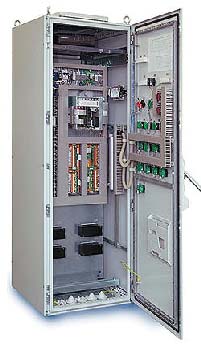
Шкаф - защищенное НКУ, предназначенное для установки на полу
Safety enclosed boards are used for most new installations. Common terms used to designate equipment of this type are metal-enclosed switchgear and metal-clad switchgear.
Most safety enclosed boards are of the unit or sectional type. They consist of a combination of the desired number and type of standardized unit sections.
Each section is a standard factory-assembled combination of a formed steel panel and apparatus mounted on a steel framework.
Safety enclosed switchgear may be classified with respect to purpose of application as follows:
1. General medium- or high-voltage switchgear
2. Primary unit substations
3. Rectifier unit substations
4. Secondary unit substations or power centers
5. General low-voltage switchgear
6. Low-voltage distribution switchboards
7. Motor-control-center switchboards
[American electricians’ handbook]Тематики
- НКУ (шкафы, пульты,...)
Классификация
>>>Обобщающие термины
Синонимы
EN
- enclosed assembly (of switchgear and controlgear)
- enclosed switchboard
- safety enclosed board
- safety enclosed switchgear
DE
FR
Немецко-русский словарь нормативно-технической терминологии > geschlossene (gekapselte) Schaltgerätekombination
-
10 PBEIST
сокр.воен. (Planning Board for European Inland Surface Transport) Planungsausschuß Europäischer Binnenverkehr auf dem Land- und Wasserwege -
11 Nagelfeile
f nail file* * *die Nagelfeilenail file* * *Na|gel|fei|lefnailfile* * *die1) (a small flat strip of wood or card coated with emery powder and used for filing the fingernails.) emery board2) (a small instrument with a rough surface, used for smoothing or shaping the edges of one's finger-nails.) nail-file* * *Na·gel·fei·lef nail file* * *die nail file* * *Nagelfeile f nail file* * *die nail file* * *f.nail file n. -
12 verkleiden
verkleiden v 1. line, surface, clad, face (Fronten, z. B. mit Naturstein); slate (mit Schiefer); 2. sheathe (verschalen); line with boards, board, plank, box up, timber, panel (mit Brettern); batten (mit Leisten); 3. case, clad, jacket (ummanteln); 4. DIS lag (mit Dämmstoffen); 5. TE revet (Böschung, Fundament)Deutsch-Englisch Fachwörterbuch Architektur und Bauwesen > verkleiden
См. также в других словарях:
Board — may refer to: *Board, a piece of lumber, or other rigid material made of wood, milled or sawn flat *Surfboard, skateboard, or snowboard (often made of fibreglass) *Board of directors or a similar governing or advisory committee *Mixing console,… … Wikipedia
Surface-mount technology — (SMT) is a method for constructing electronic circuits in which the components (SMC, or Surface Mounted Components) are mounted directly onto the surface of printed circuit boards (PCBs). Electronic devices so made are called surface mount… … Wikipedia
Board — (b[=o]rd), n. [OE. bord, AS. bord board, shipboard; akin to bred plank, Icel. bor[eth] board, side of a ship, Goth. f[=o]tu baurd footstool, D. bord board, G. brett, bort. See def. 8. [root]92.] 1. A piece of timber sawed thin, and of… … The Collaborative International Dictionary of English
Board and board — Board Board (b[=o]rd), n. [OE. bord, AS. bord board, shipboard; akin to bred plank, Icel. bor[eth] board, side of a ship, Goth. f[=o]tu baurd footstool, D. bord board, G. brett, bort. See def. 8. [root]92.] 1. A piece of timber sawed thin, and of … The Collaborative International Dictionary of English
Board of control — Board Board (b[=o]rd), n. [OE. bord, AS. bord board, shipboard; akin to bred plank, Icel. bor[eth] board, side of a ship, Goth. f[=o]tu baurd footstool, D. bord board, G. brett, bort. See def. 8. [root]92.] 1. A piece of timber sawed thin, and of … The Collaborative International Dictionary of English
Board of trade — Board Board (b[=o]rd), n. [OE. bord, AS. bord board, shipboard; akin to bred plank, Icel. bor[eth] board, side of a ship, Goth. f[=o]tu baurd footstool, D. bord board, G. brett, bort. See def. 8. [root]92.] 1. A piece of timber sawed thin, and of … The Collaborative International Dictionary of English
Board rule — Board Board (b[=o]rd), n. [OE. bord, AS. bord board, shipboard; akin to bred plank, Icel. bor[eth] board, side of a ship, Goth. f[=o]tu baurd footstool, D. bord board, G. brett, bort. See def. 8. [root]92.] 1. A piece of timber sawed thin, and of … The Collaborative International Dictionary of English
Board wages — Board Board (b[=o]rd), n. [OE. bord, AS. bord board, shipboard; akin to bred plank, Icel. bor[eth] board, side of a ship, Goth. f[=o]tu baurd footstool, D. bord board, G. brett, bort. See def. 8. [root]92.] 1. A piece of timber sawed thin, and of … The Collaborative International Dictionary of English
Board to board connectors — Board to board (BTB) connectors are used to connect printed circuit boards (PCB), electronic components that contain a conductive pattern printed on the surface of the insulating base in an accurate and repeatable manner. Each terminal on a BTB… … Wikipedia
board — [bôrd] n. [ME & OE bord, a plank, flat surface (nautical senses via OFr bord, side of a ship < Frank * bord, akin to OE bord) < IE * bhr̥dho , board < * bheredh < base * bher , to cut] 1. a long, broad, flat piece of sawed wood ready… … English World dictionary
Surface Transportation Board — The Surface Transportation Board [1] of the United States is a bipartisan, decisionally independent adjudicatory body organizationally housed within the U.S. Department of Transportation. The STB was established in 1996 to assume some of the… … Wikipedia
